
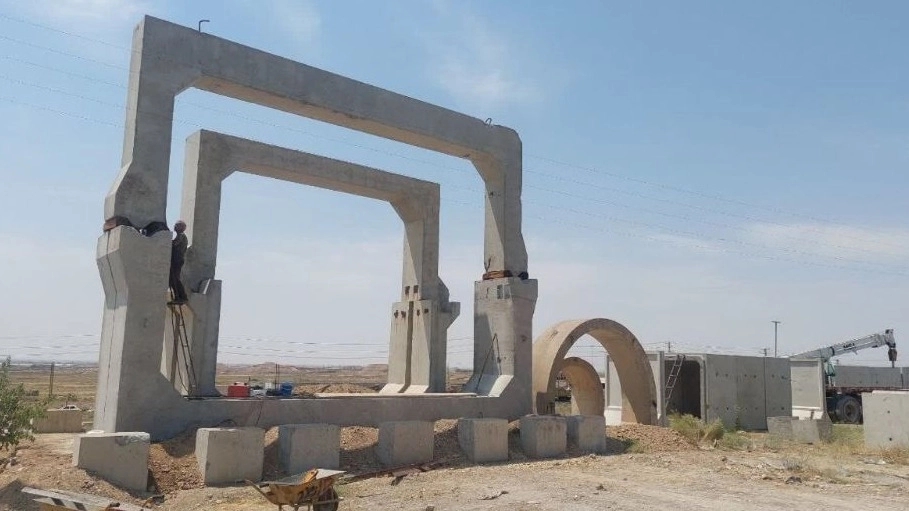
Construction of an explosion -proof trench with a comprehensive guide to secure shelters
In today's risky world, the need for safe and resistant structures of various threats, including the explosion, is felt more than ever. From military installations and strategic data centers to personal and industrial shelters, construction of armed concrete trenches is recognized as a key and reliable solution. Reinforced concrete is an ideal material for absorbing and neutralizing massive energy caused by its unique features, including high compressive strength, ductility and durability. This article examines a comprehensive examination of technical principles, techniques and technical considerations in the construction of armed concrete trenches and shows why the choice of appropriate materials and contractor, such as the Ducal Concrete Company , plays a vital role in the success of these projects.
Why is reinforced concrete the best choice for explosion -proof trench?
When an explosion occurs, a high -speed pressure wave is released around. The wave has two main phases: a positive pressure phase (which causes initial compression and destruction) and the negative pressure phase (which creates suction force and can pull damaged structures). To counter these complex dynamic forces, building materials must have specific characteristics.
Company Duchess Concrete With a deep understanding of these features, concrete with special mixing design for defense and security projects produces the highest level of performance in explosive loading conditions.
Key principles in designing and building an explosion -proof trench with reinforced concrete
The design of an effective shelter goes beyond the construction of thick walls. This process requires precise engineering analysis and principles that are important in their place.
1. An explosive threat analysis and loading
The first step is to identify the threat scenario. Engineers need to know what kind of structure and intensity of the explosion must resist. Key parameters are:
- TNT Equivalent Weight: The explosion power is usually expressed by the equivalent of its weight to the trianitrotolue (TNT).
- The explosion distance from Standoff Distance: This is the most important factor. The greater the distance, the lower the pressure on the structure.
- The type of explosion: Air Burst, Surface Burst, or Subsurface Burst each create different loading patterns.
With this information, engineers can calculate parameters such as Reflected Pressure, Side-On Pressure, and Impulse. These calculations will be the basis of structural design in the process of constructing an explosion -proof trench with reinforced concrete .
2. Structural design and reinforcement details
After determining the loads, the design of the structural components begins. Here are some fundamental differences with the design of ordinary buildings:
- Thickness of the wall and ceiling: The thickness of concrete elements is directly related to the amount of explosion resistance. These thicknesses are usually much greater than conventional structures.
- dense and special reinforcement: In the construction of an explosion -proof trenches with reinforced concrete , dense rebar networks are used in both the interior and exterior of the walls and ceilings. This is essential to counter bending in both directions and to prevent scabbing & spalling from being thrown into the shelter.
- End hooks and mechanical patches: to ensure the full connection of the reinforcement and prevent them from being removed (135 degrees). (Overlap) used.
- Diagonal Bars: Qatari bars are used to strengthen and distribute stress better in the corners and location of wall -to -ceiling and floor. These details play a vital role in preventing corners failing.
3. The quality of concrete: the vital role of the mixing design
The quality of the concrete used in Making an explosion -proof trench with reinforced concrete is of great importance. Normal concrete is not suitable for this. The required concrete must have the following features:
- High-strength concrete ( is usually used with a resistance above C40 (40 MP).
- Fiber-Rinforced Concrete-Frc): The glass to the concrete mixture greatly increases its tensile strength and its plague. These fibers act as a 3D microscopic reinforcement network and prevent cracks from creating and expanding the cracking phenomenon.
- Concrete with extraordinary performance (UHPC): In highly sensitive projects, Ultra-High Performance is used. This advanced material has a compressive strength of more than 150 MPa and very high ductility and can provide more resistance to lower thicknesses.
Company Duchel Concrete as one of the pioneers of producing specific concrete is capable of producing and supplying high -resistant fiber and concrete concrete, which are specifically optimized for defense applications and projects construction of armed concrete
Implementation of Concrete -Concrete Concrete Construction Process
The implementation process requires accuracy, continuous monitoring and compliance with strict standards.
Step One: Digging and preparing foundation
Depending on the design, the trenches can be buried, semi -finished or on the surface of the ground. The excavation should be carefully performed and the soil under the foundation reaches the required density. Running a layer of concrete unless (cleaning) is essential to prepare the foundation of the foundation reinforcement.
Step Two: Reinforcement of Foundation and Walls
This is one of the most sensitive stages of construction of an explosion -proof trench . The bars must be woven exactly according to the executive maps. The interval of the bars, their size, the length of the bending and how they are connected to each other must be carefully controlled by the monitoring team.
Step Three: Molding and Concrete
Molds should be strong enough to withstand the hydrostatic pressure of fresh concrete and its high weight. Concrete should be performed continuously to prevent the creation of a cold join, which is a structural weakness. Vibrator is required to compress the concrete and exit the imprisoned air.
Step Four: Curing Practice
Concrete requires moisture and temperature to achieve its final resistance. Proper procedure (usually by keeping the concrete surface moist for at least 1 to 2 days) has a direct effect on the durability and final strength of the structure. This step is very key to the success of the project Concrete Concrete Trenches .
Step Five: Design of Door and Open
Doors, ventilation valves and other openings are the weakest spots of an explosion -proof trench. These components must be specialized and manufactured. The explosion -proof doors are usually made of thick steel layers and have several locks and tabs that are locked in the steel framework in the concrete.
The role of Ducal Concrete Company in quality and security assurance
Choosing the right material and executor makes the difference between a real safe structure and an unreliable shelter. Duchess of Concrete The company plays an unparalleled role in sensitive projects, relying on the technical knowledge of the day and extensive experience in the production of concrete.
- Custom Concrete Production: We do not just produce standard concrete in Duchels . Our research and development team is able to design and produce concrete mixing based on the specific needs of your project, including explosion resistance.
- Raw material quality assurance: We use the best and most quality cement, aggregates and additives. All raw materials are controlled before use in our equipped laboratory.
- Continuous quality control: from the moment of concrete production in batching until delivery at the project site, the concrete quality is constantly monitoring by our experts. Experiments of compressive resistance, Islamap and other concrete specifications are routinely performed.
- Specialized Advice: Our experts are ready to consult with the best type of concrete for the project Concrete Concrete Trenches to ensure maximum efficiency and safety.
Trust Concrete Duchess means to entrust the security of their structures to the professionals who have put the quality at the forefront of their work.
Conclusion
Construction of an explosion -proof trench with reinforced concrete is a complex and multi -faceted engineering process that requires a deep understanding of the explosion dynamics, material behavior and accurate executive techniques. From the initial threat analysis to the design of the reinforcement and the selection of the appropriate concrete mixing design, each step has a vital role in the final performance of the structural. Reinforced concrete remains as a golden standard for building shelters due to its high mass, compressive strength, and dilemma.
In the meantime, the quality of concrete as the core of structural resistance should never be overlooked. Choosing a reputable supplier, such as the Duchess of Concrete , which is capable of producing specific and engineered concrete for defense applications, is a direct investment in human security and life. By adhering to the principles of engineering and the use of high quality materials, structures can be built that are a safe haven against the most difficult threats.